A Square with Edges or an Open Plaza?
Compare a square with edges or an open plaza to see how boundaries affect orientation, shelter and gathering, and decide which features suit the space.
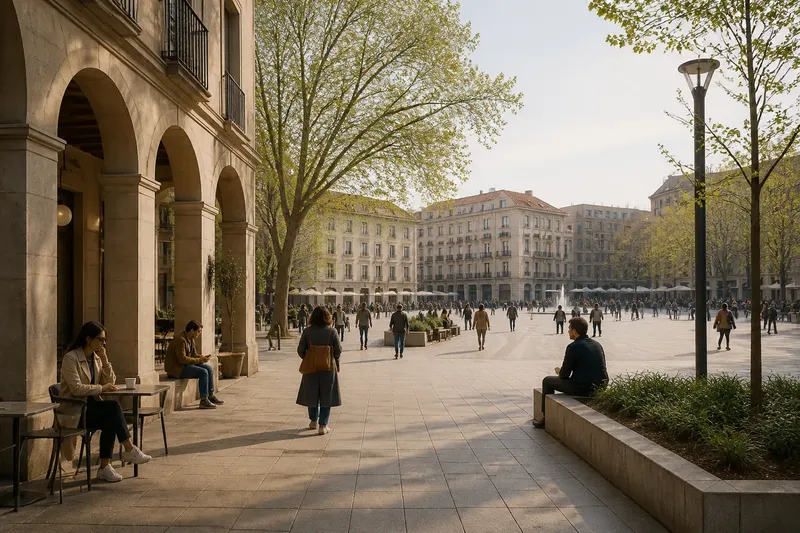
Which works better for an everyday meeting place: a square with edges or an open plaza? A square with edges or an open plaza gives people different cues for finding their way, getting out of the weather and deciding where to gather. Compare how the boundaries work, not just how much paving or planting the space contains.
Read the boundary before choosing a label
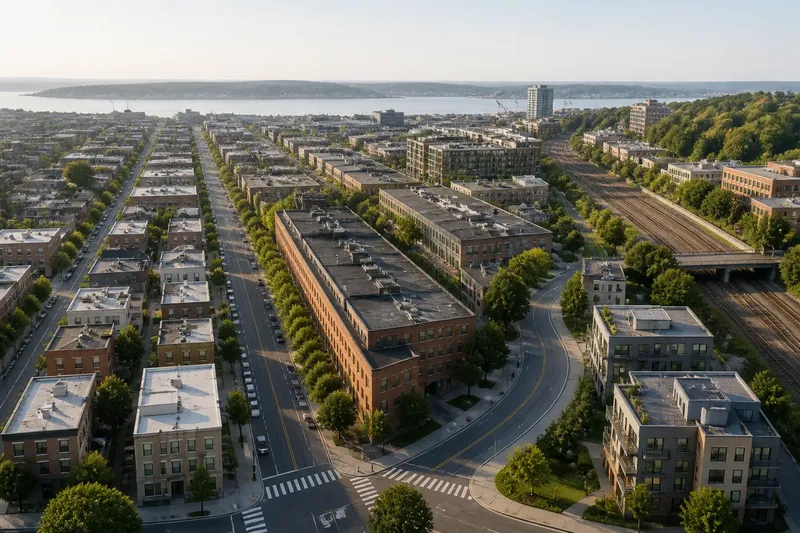
“Square” and “plaza” are useful shorthand, but they do not tell you exactly how a place behaves. An enclosed square may have building fronts, arcades, walls, trees or a noticeable change in level around much of its perimeter. An open plaza may meet surrounding streets with few visual or physical interruptions. Many places combine both: a broad paved forecourt might have a colonnade on one side, while a small square might open onto a busy road.
Identify what a person can read from the space itself. Can you see its limits? Is there a sheltered side? Are the entrances obvious? Do the edges offer places to sit, wait or stand without blocking movement? Record each feature separately. A tall building can make a space feel enclosed without offering a comfortable place to pause; a low planter can mark a boundary without hiding what lies beyond.
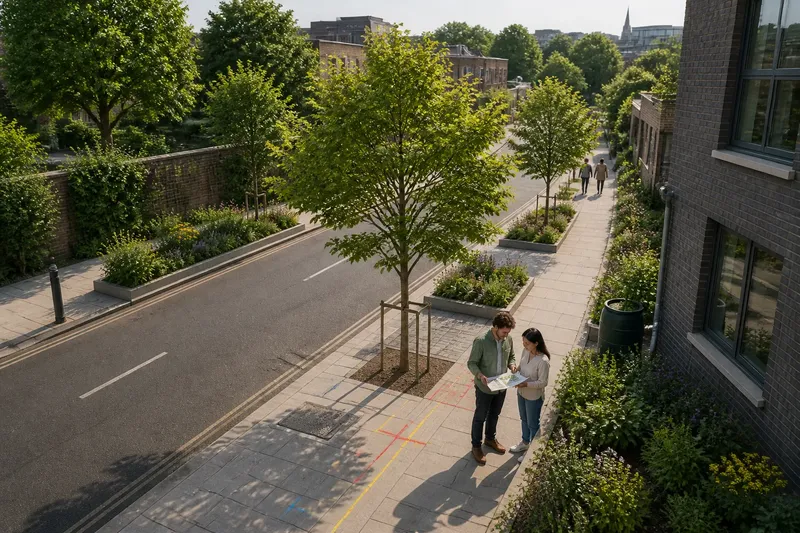
Start with a simple sketch. Mark the main approaches, building entrances, trees, benches, covered areas and routes across the space. Add arrows for the directions people commonly arrive from. This is not a design survey. It is a way to connect each observation to a specific place.
Check how the space helps people find their way
Visit when the space is active and notice how people choose a direction as they enter. Do they move straight across, follow an edge or pause to look around? Can they see a destination such as a library door, fountain, tram stop or café terrace? An enclosing frontage can make a square feel like a distinct room in the city. Its corners and openings can also frame routes and show visitors where to go next.
Open plazas tend to offer longer views. That can make destinations easier to spot, especially from across a wide street. But a large, uninterrupted surface may provide fewer cues about where to stop or which route is intended for walking. Notice whether people use paving bands, lamp posts, signs or the alignment of nearby façades to organise their movement.
At each entrance, check whether public routes are clear. A wide opening is not automatically easier to understand than a narrow one. A visible destination can help, while several competing routes may leave a first-time visitor unsure which way to turn. Record the cue that seems useful: a doorway, path, sign or visible cluster of people.
Compare shelter with exposure
Return in different weather if you can. Note where people wait in drizzle, wind or strong sun. Arcades, awnings, recessed entrances and tree canopies can make parts of an edge more comfortable. A broad open plaza may offer little relief in its centre, even when its perimeter provides shade or cover.
Ask whether shelter is in the right place. A covered walkway beside a closed frontage may protect someone crossing the space but offer nowhere to sit. A line of trees may provide shade while leaving a busy entrance exposed. If the only comfortable spot is beside a café, consider whether people who are not customers can use it freely.
Edges can give people a choice between sheltered and exposed positions. Someone might sit beneath an arcade, stand near a doorway or remain in the open to watch an event. In a plaza with sparse edges, that choice may be harder. Note whether temporary shade, movable seating or a sheltered transit stop adds options without interrupting the main route.
See how gatherings fit without blocking movement
Visit during a market, lunchtime rush, performance or other regular gathering if one occurs. Do people form a line along the edge, gather around a focal point, spread across the centre or pass through without stopping? The sides of a square may give a small group a sense of focus and help contain conversation. They can also leave little room when a crowd grows or a queue reaches a doorway.
An open plaza can accommodate a broad assembly, event layout or informal play because its centre may have fewer fixed obstacles. That flexibility is not the same as comfort. Without seating, shade or a clear distinction between event space and walking routes, people may have room to gather but little reason to stay. Look for practical supports: power access for events, benches at the margins, clear paths for through-movement and nearby places to rest.
Notice who can use the gathering space without joining an organised activity. Can someone sit alone and watch? Can a parent stay near a child without blocking a route? Is there a quieter edge for conversation away from a speaker or crowd? A public space can offer different levels of activity within easy reach rather than forcing every activity into one spot.
Look closely at edges and seating
When the crowd thins, inspect what the boundary contributes at human scale. Ground-floor doors, transparent windows, low walls and shopfronts can help people understand whether an edge is active, passable or private. A blank wall can still define a square, but may give passers-by fewer reasons to linger. A railing may keep a route clear while separating a gathering from nearby streets.
Check how seating relates to the edge. Benches facing a central feature encourage watching; seats alongside a wall may suit conversation or a short rest. A ledge can invite sitting, but its height and surface affect comfort and access. Note whether seating is in sun, shade or a draft, and whether a seated person has a clear route to an entrance.
Not every boundary should be opened up. A stronger edge can protect a quiet seating area from a busy street. It may also make the public space feel smaller or less connected to nearby destinations. Judge the boundary by what it lets people do and what it makes harder.
Questions people ask about squares and plazas
Does an enclosed square feel easier to navigate?
A recognisable perimeter can help visitors understand where the space begins and ends. Clear openings and visible destinations matter too; a defined edge is less useful if entrances are hard to spot.
Can an open plaza provide shelter?
Yes, if its edges include arcades, canopies, trees or sheltered waiting areas. Check where those features sit in relation to the routes people use, rather than judging the whole plaza by its most sheltered corner.
Which form suits a public event?
An open centre can make a temporary gathering easier to arrange, while an enclosed square may give a smaller event a more focused setting. The right fit depends on access, circulation, shade, seating and the need to keep some routes clear.
What if a place has both open and enclosed qualities?
Describe its parts separately. A space may open towards a station and feel enclosed along a quiet garden edge, allowing one side to support movement and another to support lingering.
Turn observations into a focused change
Review your notes for recurring patterns rather than ranking spaces by appearance. Mark which routes are clear, where people find shelter and where gatherings form without obstructing movement. Separate what you observed from what you infer. A crowded corner may be a useful meeting point, but it could also be the only place with shade.
Say you are considering a redesign for an invented neighbourhood plaza with a busy bus stop on one side and an exposed paved centre. You note that people waiting for buses cluster beside a narrow canopy, while others cross the open area quickly. You propose extending a sheltered waiting edge and adding seats near, but not across, the main route. The expected observable result is more room for people to wait without merging with passers-by. A later visit can check whether the route remains clear; if it does not, the seating position needs to change.
Use targeted adjustments rather than choosing a form as a package. If a plaza needs clearer orientation, a more legible entrance or a tree line marking a route may help. If a square feels cramped during events, a clearer open area or a better arrangement of seating at its edges may help. Changes to buildings, access or public routes should follow relevant local requirements, with qualified professional advice where needed.
It is not worth trying to count every person or assign a single purpose to each visit. Brief, repeated observations of routes, stopping points and responses to the weather are more useful than a record so elaborate that no one can maintain it. Use the same simple sketch each time and note what changed with the conditions.
The best choice is not always a fully enclosed square or a completely open plaza. A city may need a visible edge in one place and a generous opening in another. For a square with edges or an open plaza, judge the boundary by whether it helps people arrive, orient themselves, find a comfortable place and gather without making ordinary movement difficult.